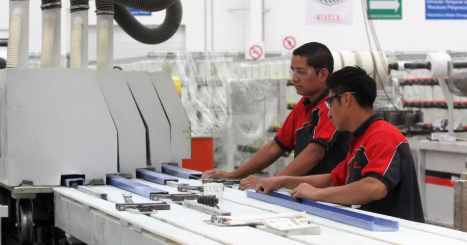

The manufacturing industry in Baja California has begun to experience a slowdown in investments and expansion projects due to the uncertainty generated by U.S. tariffs and the upcoming review of the United States-Mexico-Canada Agreement (USMCA), warned Cecilia del Carmen Ortega Covarrubias, director of Global Customs Strategies (OCEGA).
In a press conference, she explained that this situation has had such an impact that there are between eight and ten vacant industrial buildings in the state, and companies have reduced their planning horizons.
Senator Verónica Martínez lamented the company’s closure and said she will meet with the Undersecretary of Mining.
Furthermore, the foreign trade specialist maintained that the state has experienced a slowdown in manufacturing activity during 2025 and 2026, stemming from various macroeconomic factors and the prevailing uncertainty surrounding U.S. trade policy.

“We have approximately eight to ten vacant industrial buildings in Baja California. Some maquiladoras have closed; however, it’s also important to note that there is investment, and efforts are underway to ensure that this investment remains,” he stated.
Although he didn’t mention investment amounts, he explained that previously, workers could easily move from one maquiladora to another due to the high demand for labor in the sector.
However, he warned that the situation has changed in recent months, as many people are now looking for work.
“Today, we’re seeing something never before seen in Baja California: lines of people looking for jobs; whereas before, people would move from one maquiladora to another precisely because there was such a large supply of work,” he explained.
Given this context, the president of the Tijuana National Chamber of Commerce (Canaco Tijuana), Olivaldo Paz, confirmed that one of the main factors generating caution among companies is the uncertainty surrounding tariffs and the review of the North American trade agreement.
This scenario has forced them to modify their planning strategies.
“The maquiladoras can’t prepare annual budgets because we don’t know what will happen with the tariffs.”
“There’s a lot of uncertainty surrounding the renegotiation of the USMCA. Budgets that used to be prepared for a year are now being prepared for six months,” he emphasized.
He specified that the medical device, electronics, aerospace, and automotive sectors are among the most exposed to changes in the rules of origin, as well as to the new tariffs on steel and aluminum.
He said that in the review of the USMCA, it will be necessary to protect the rules of origin, since a product can cross the border up to five times.
“A sheet of metal can come in, be manufactured into a part, return to the United States, come back to Mexico, and be transformed again. Therefore, determining the origin of the inputs is becoming increasingly complex,” he explained. Despite this scenario, he affirmed that foreign investment continues to see opportunities in Mexico, and particularly in Baja California, although with greater caution in decision-making.
“Foreign investment is still betting on Mexico, and maquiladoras are still preparing their budgets, even if only six months in advance. They continue to believe in us, they continue to invest in us,” he explained.
Therefore, he emphasized that the business organization maintains an ongoing strategy to promote new investments in the state, leveraging the logistical and commercial advantages of the border region.
Finally, he reaffirmed that industrial facilities and a skilled workforce are available in the state for those interested in investing in Tijuana.
Sorce: milenio