
The increasing wait times to enter Baja California from the United States have emerged as a new threat to the border economy, tourism, and the quality of life of thousands of cross-border workers.
This warning was issued by Octavio Sandoval López, Coordinating President of the state’s Business Coordinating Councils (CCE), who issued an urgent appeal to the State Government to implement immediate measures to expedite access through international border crossings.
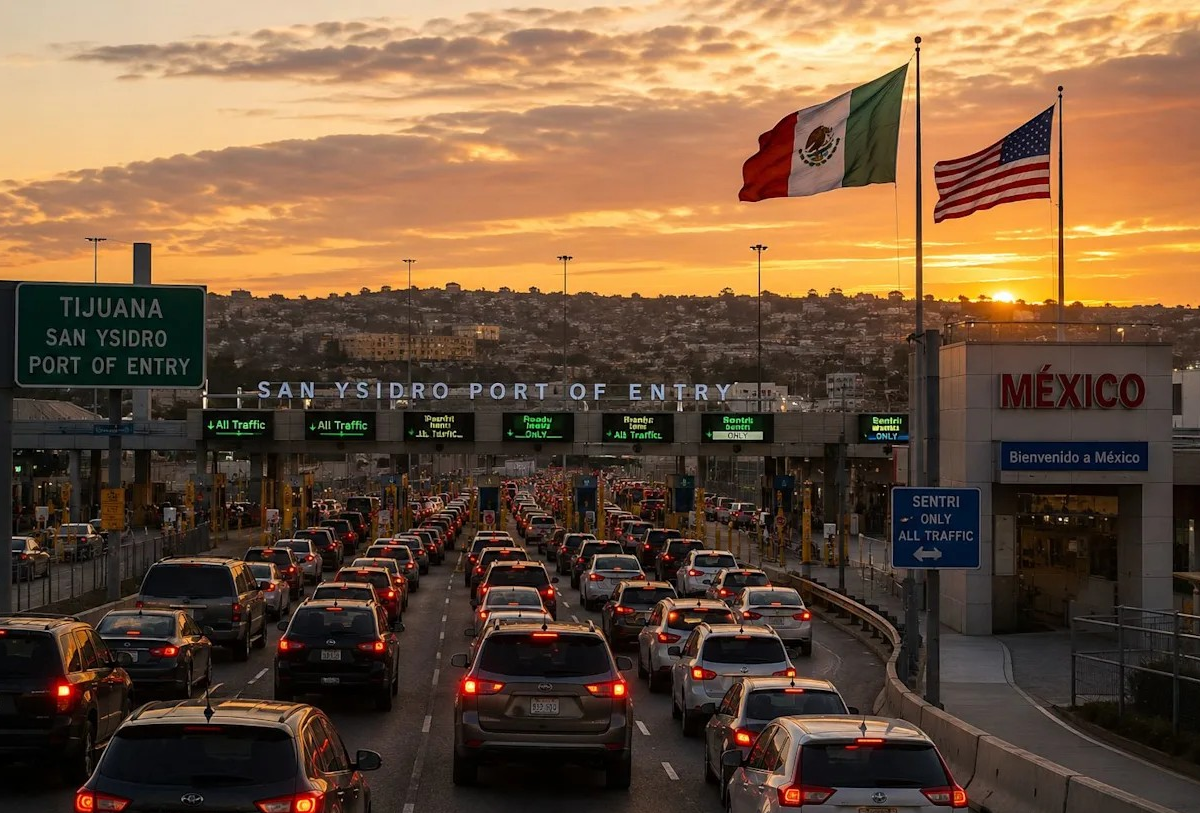
According to a statement released by the business sector in Mexicali, border crossings into Baja California are currently experiencing wait times of up to two hours during standard operating hours—particularly between 4:00 p.m. and 8:00 p.m. The situation worsens on Fridays and Saturdays, when lines to enter Mexican territory can stretch to four hours.
This phenomenon is no longer merely an inconvenience for motorists; it has evolved into a structural problem affecting binational mobility, regional competitiveness, and the economic vitality of the entire Cali-Baja border region.

The Baja California CCE asserts that the partial operation of entry lanes—combined with slow and intermittent inspections—is creating a bottleneck that daily impacts thousands of people who reside in border cities such as Tijuana, Mexicali, and Tecate, yet work in California.
In one of the continent’s most dynamic regions—where daily life depends on constant interaction between both sides of the border—delays at border crossings translate into millions in economic losses regarding productivity, consumer spending, and tourism.
Every day, tens of thousands of workers cross into the United States to work in sectors such as healthcare, construction, services, logistics, retail, and manufacturing. Many of them return to Baja California in the late afternoon or evening, only to face hours trapped in lines waiting to get back to their homes.
The toll is not solely economic. It also entails a deterioration in quality of life, strain on family relationships, chronic stress, increased fuel consumption, and higher levels of environmental pollution resulting from vehicles idling for hours on end. The business community’s statement further warns that the problem is beginning to stifle both traditional tourism and medical tourism—two sectors fundamental to Baja California’s economy.
This is no minor concern. In recent years, Baja California—particularly Tijuana—has established itself as one of Latin America’s leading destinations for medical tourism, attracting thousands of visitors from Southern California seeking dental services, surgeries, cosmetic treatments, and specialized care.
However, business leaders in the tourism and restaurant sectors have begun reporting cancellations, a decline in spontaneous visits, and a growing sense that crossing into Mexico becomes less appealing when wait times become excessive.
The border between Baja California and California constitutes one of North America’s most vital economic corridors, serving as a hub for manufacturing, logistics, foreign trade, tourism, and supply chains linked to nearshoring.
Against this backdrop, the CCE (Business Coordinating Council) emphasizes the need to strike a balance between security and mobility—acknowledging the importance of maintaining border inspection protocols while ensuring they do not ultimately compromise the dignity or waste the time of those who work in, shop in, or visit Baja California.
Prominent among the proposals put forward by the business sector is the implementation of “trusted traveler lane” schemes—similar to the SENTRI model—specifically designed for cross-border workers and frequent visitors.
“Today, more than ever, we need to boost the regional economy and facilitate border mobility—not create obstacles that end up stifling the state’s economic and tourism activity,” concluded the statement, signed by Octavio Sandoval López.

Source: es-us.noticias.yahoo.